

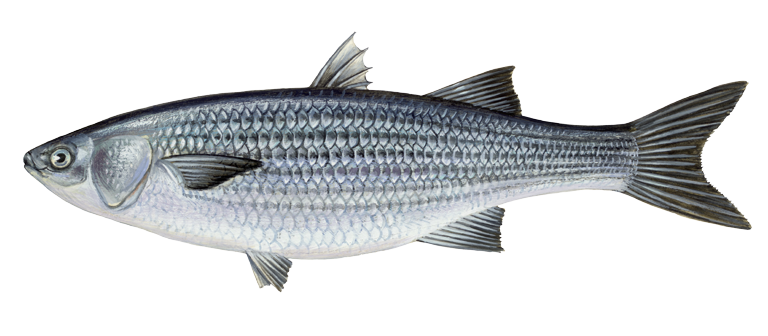
Mullet is a durable and flavorful fish belonging to the Mugilidae family. It has a long, strong body, a gray or olive-green back, and silver-colored sides.
Physical Characteristics and Habitat
- Its body is elongated, slightly compressed from the sides, and covered with large scales.
- Its back is gray, bluish-gray, or olive green, while its sides and belly are silver-white.
- It is a strong and agile fish with a small mouth and usually moves in schools.
- It can live in seas, shallow coastal waters, lagoons, harbors, and river mouths.
- It is highly tolerant of changes in salinity and may occasionally enter freshwater areas.
- In Türkiye, it is commonly found along the coasts of the Black Sea, the Sea of Marmara, the Aegean Sea, and the Mediterranean Sea.
- It mainly feeds on algae, small aquatic organisms, organic matter, and food found on the seabed.
Mullet Calorie Content
100 grams of mullet contains 117 kcal. A medium serving of 150 grams contains approximately 176 calories.
| Nutritional Value | Per 100 Grams | 1 Serving (150 g) | Daily Value per 100 Grams* |
|---|---|---|---|
| Calories | 117 kcal | 176 kcal | 5.9% |
| Carbohydrates | 0.0 g | 0.0 g | 0.0% |
| Fiber | 0.0 g | 0.0 g | 0.0% |
| Protein | 19.4 g | 29.1 g | 38.8% |
| Fat | 3.8 g | 5.7 g | 5.8% |
| Cholesterol | 49.0 mg | 73.5 mg | 16.3% |
| Vitamin A | 123 IU | 185 IU | 2.5% |
| Vitamin C | 1.2 mg | 1.8 mg | 2.0% |
| Potassium | 357 mg | 536 mg | 10.2% |
| Calcium | 41 mg | 62 mg | 4.1% |
| Iron | 1.0 mg | 1.5 mg | 5.6% |
*Daily values are calculated based on an average 2,000-calorie diet. Nutritional values are approximate and may vary depending on the species, season, fat content, storage conditions, and cooking method of the mullet.